Sell your waste cardboard
Baled or loose, collected from your site or delivered into ours. Mill-specification OCC, and you get paid for it.
We work with businesses producing cardboard regularly and in volume. Business sellers only.
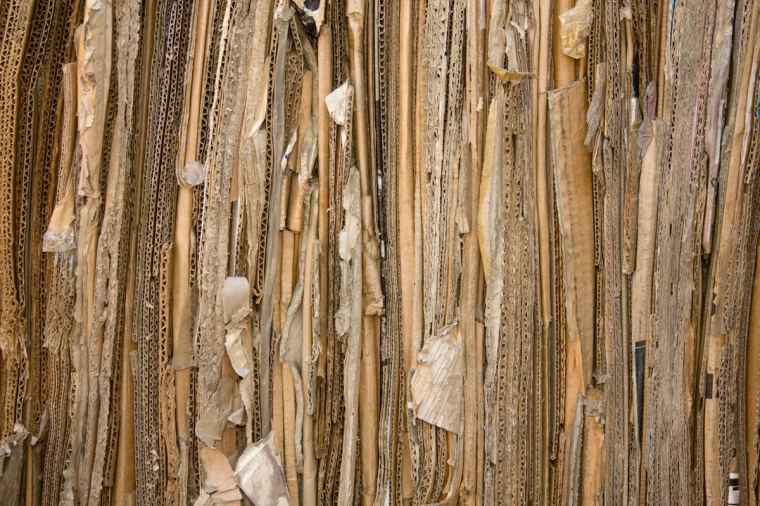
Tell us what you have and we'll come back with how we'd handle it and what we'd pay.
Cardboard is the one waste stream almost every operation produces, and the one most often treated as a cost. If yours is going into a compactor or a general waste skip, you are paying to remove material that has a market.
Greenview buys recovered cardboard from businesses across the UK. We collect baled material from your site, or you can deliver loose or baled cardboard into our Garthorpe site, just outside Melton Mowbray, and we bale it here. Either route works, and which one suits you is an operational question rather than a commercial one.
How commercial cardboard recycling works
Recovered cardboard is traded as OCC, old corrugated containers, and it is graded before it goes anywhere. The European standard, EN 643, is what mills and merchants across the UK work to.
The distinction that matters most for cardboard is between 1.05 and 1.04. Grade 1.05 is used boxes and sheets of corrugated board: essentially pure corrugated. Grade 1.04 is packaging that is at least 70% corrugated, with the balance made up of solid board and wrapping papers, the sort of mixed stream a supermarket or a busy warehouse produces. Both are traded. Which one your material is depends on what else ends up in the bale.
Mills buy to specification, so what determines where a load goes is what is in it. Sorting and baling to grade is the work we do between your site and the mill.
Cardboard and board grades we take
- OCC 1.05 Used boxes and sheets of corrugated board, various qualities. The standard cardboard grade.
- OCC 1.04 Packaging that is at least 70% corrugated, the balance solid board and wrapping papers.
- Corrugated kraft Used corrugated with kraft liners.
- Kraft sacks Used or unused, wet-strength or not, printed or plain.
- Carrier kraft Converter and packaging-producer waste, printed or unprinted.
- Cardboard cores and tubes Paper and board cores from reels of film, paper, textiles and tape. Baled or loose.
- Redundant printed stock Obsolete, misprinted or discontinued cartons and packaging. Often clean, single-grade material.
Preparation and quality
Baled. Mill-size bales, strapped and stable, are the simplest material to move. If you already bale, we can collect from you or you can deliver into us, whichever fits your operation.
Loose. If you do not bale, you can deliver loose material into our site and we bale it here. We take it in any condition when it comes to us.
What affects the grade. Cardboard needs to be dry. Wet or waxed board, polystyrene, plastic film, food residue and general waste all pull a load down a grade or make it unsuitable. Tape and labels in normal quantities are fine. Single-material loads are worth more than mixed ones, which is a statement about the material rather than about how it reaches us.
Who we work with
- Distribution centres and warehousing
- Retailers and multi-site operations
- Manufacturers and production sites
- Printers, converters and packaging producers
- Logistics and fulfilment operations
- Food and drink producers
Why Greenview
Transparency
Clear on what we pay and why, with a full audit trail on every load.
Reliability
Collections when we say, and material moved before it backs up.
Flexibility
Collect from your site, or deliver into ours. Whichever fits your operation.
Compliance
Proper duty-of-care and waste-transfer paperwork, every time.
What to tell us
- 01What the material is, and whether it is corrugated, kraft, cores or mixed
- 02Roughly how much comes off site, and how often
- 03Whether it is baled or loose, and whether you have baling capacity
- 04How it currently leaves site
- 05Your location
Tell us what you produce.
Whatever the material, the first step is the same. A short conversation about volumes, how it comes off site, and where it goes from there.
Start an enquiry